By Scott Etkin
While we wait to see whether the city’s composting and containerization programs can successfully reduce New York’s rat population (by isolating food scraps and other trash in rat-proof containers), it’s worth a look at how another city experiment is faring at keeping rats at bay.
In 2022, the Lincoln Square Business Improvement District – which roughly covers West 58th to 70th Street – began participating in a pilot program known as “Clean Curbs,” aimed at reducing litter from sidewalk trash receptacles on many Upper West Side street corners. The waste in these containers is what’s thrown out by the public when they’re on the street – making it separate from the residential and commercial trash targeted by the composting and containerization programs. The city, not residents or businesses, is responsible for these street containers, which can overflow, spilling onto sidewalks and attracting vermin.
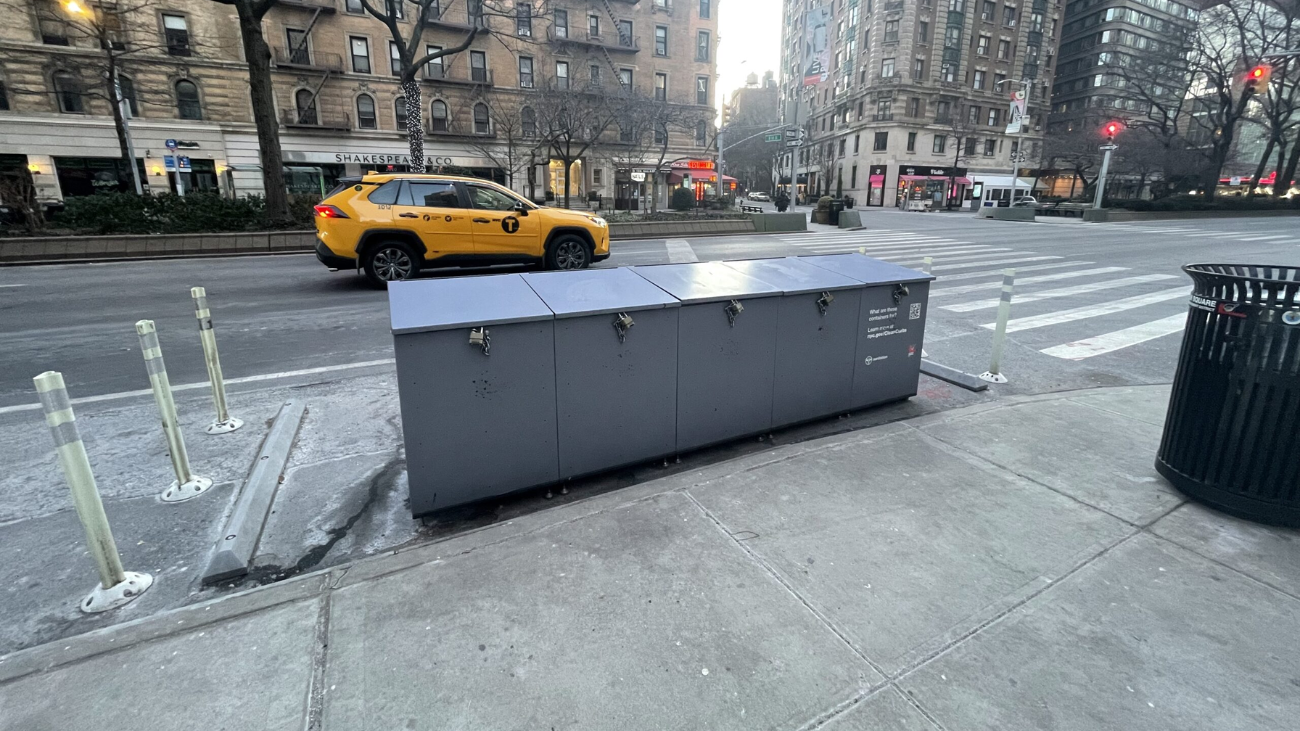
Under the Clean Curbs program, receptacles in the UWS pilot area are emptied several times a day by the Lincoln Square BID, and the contents are then stored in locked, rat-proof containers, to be collected by the city’s Department of Sanitation. A West Side Rag article on the initiative from shortly after it started generated a vigorous 65 comments – expressing everything from deep skepticism that it would be effective, to enthusiastic optimism that the containers (rectangular metal boxes placed in street parking spaces) would make a real difference.
So, how has the program turned out? And does the BID’s experiment offer any hope for a rat-free neighborhood?
More than two years into the experiment, it has been scaled up. An additional four containers have been added to the West 60s, bringing the total number of bins to six. That may not sound like a lot, but some 300 bags of trash are deposited in those six bins every day. The bags put there are collected by BID’s “Clean Team,” 15 contracted maintenance workers who empty receptacles and sweep up the public’s trash throughout the neighborhood every day from 7 a.m. to 8 p.m. (9 p.m. on the weekends).
“Getting garbage bags off the sidewalks is really terrific,” said Monica Blum, president of the Lincoln Square BID, on a call with the Rag. But Blum acknowledges the system isn’t perfect yet. On holidays, for example, when there are no pick-ups, the bags from street corner receptacles end up on the sidewalk, and not in the metal boxes, she said.
And because transferring the full bags of trash to the metal bins is no small task, figuring out the tools the Clean Team needed for the job took some learning, Blum said. Some Clean Team members are now equipped with tandem rolling trash barrels so they can more easily move collected trash bags before bringing them to the stationary containers.
Another lesson the BID learned is how to keep the bins clean of the liquid that inevitably seeps out of garbage bags. The Clean Team power-washes the bins, inside and out, once a week. “The maintenance of them is key, but it’s also time-consuming,” said Ralph Memoli, executive vice president of the BID.
The bins appear clean enough that Blum has spotted people sitting on them to eat lunch.
Underneath the bins is another story, which the BID discovered when an unlucky tourist from Canada dropped an earbud below a bin. The BID helped him fish it out, but the experience led to a new policy: electric leaf blowers are used once a week to clear gunk and leaves from under the bins.
While a concern when the program began was that the bins took up spaces used for parking cars, the BID said it has not received any complaints about this from the community. The bins are about the size of one parking space. In some cases, they are located on a corner, which prevents a car from taking a sharp turn through the intersection, a safety practice known as “daylighting.”
Unlike the trash containers on wheels used by businesses and small residential buildings, the bins used by the BID are stationary and locked when not in use. Blum is hoping that they do not have to be replaced once the sanitation department starts using sideloading bins – which can be emptied using a lever attached to the truck – in the coming years; the BID doesn’t have the funding to replace the existing ones, she said. Plus, she believes the current bins have been effective.
“We don’t see rats, but there are some rats in our Broadway Malls in the flower beds,” said Blum. “We’ll see how many tulip bulbs get eaten this year.”
The fight continues.